











This is an IGN opinion piece from Carlos Morales. He’s read several thousand Marvel comics and gets annoyed when adaptations don’t feel true to the characters.
Warning: this article contains spoilers for Marvel’s Wolverine.
Marvel’s Wolverine is out in the wild, marking the fourth collaboration between Insomniac Games and Marvel. But instead of being a triumphant new entry in the studio’s catalog, Wolverine has had a shaky launch, scoring a 6/10 in IGN’s official review and being savaged by online commenters. While the game isn’t as bad as the worst of the backlash would have you believe – a 6 on the IGN scale means ‘okay’, after all – it doesn’t reach the heights of Insomniac’s best games. It also highlights one of the studio’s most frustrating trends endemic to its triple-A Marvel games: the way it adapts supervillains from the Marvel universe.
All four of Insomniac’s Marvel games feature a story where the main villain is a close friend of the hero, and their falling out is the main source of the conflict. Not only is it unimaginative to keep recycling the same plot, but the recurring use of the trope has reached a new level of absurdity in Marvel’s Wolverine because it tries to tell that story with Mr. Sinister, one of Marvel’s most sociopathic antagonists. Let’s delve into why Insomniac needs a new approach to supervillains.
We’re Friends, Bub
Marvel’s Wolverine establishes an odd status quo for mutants in the world of Insomniac’s Marvel games. There are no X-Men, and Nathaniel Essex, who in the comics is traditionally the supervillain Mr. Sinister, has led the covert Team X for almost 30 years. The game opens with Essex meeting a feral Wolverine, and much of the game’s first half is spent elaborating on their shared history. Logan credits Essex with saving his life and giving him purpose, a role that in most other versions is played by Professor X. Fans of the source material figured that a twist revealing Essex’s true nature would come, and it certainly does, but the way the game executes that plot turn is muddied by how Essex is portrayed early on.
Essex is not just Logan’s friend and commander of Team X. He’s also a mutant rights activist on a crusade to make the world safe for mutants by fighting Bolivar Trask and the Reavers. Although it’s later revealed that Essex lied about being a mutant and stole the X-gene from his wife Rebecca using mad science back in the 1800s, he still spends most of the game acting like a righteous champion of mutantkind. His plan to awaken dormant mutants using Sentinels powered by the Helix Engine (and killing any humans who happen to be in the way) feels like a scheme better suited to Magneto than Mr. Sinister.

You could argue that this is a new take on Essex and shouldn’t be judged against his comic persona, but that idea falls apart when the game does have him take on his comic appearance and personality for the final level. He threatens global armageddon by unleashing a fleet of gigantic Helix Sentinels and wants to absorb all mutant X-genes into himself, but there’s no coherent development between his “I want to save mutantkind” and “I will kill everyone on Earth” mindsets.
The beginning of the conflict between Logan and Essex also falls flat because it’s largely predicated on Essex being “too violent” in his methods before he turns into an omnicidal maniac at the very end. There’s a pivotal scene where Essex tortures Trask telekinetically despite Logan’s protests, so Logan mercy kills Trask to stop his suffering. This distinction in the degrees of violence feels arbitrary when Logan spends the whole game shredding hundreds if not thousands of people with his claws, often tearing his enemies apart in brutally painful ways. Was the reveal that Essex wiped Logan’s memories and reduced him to a feral state at the start of the game not enough to spark their divide? Weirdly, that’s one of the most on-brand moments for Essex despite the developers’ odd refusal to let him fully resemble his villainous alter ego.
Sins of Sinister
Insomniac’s attempt to create an emotional falling out storyline between Logan and Essex struggles because it requires turning Essex into a completely different character from his comic incarnation. If you’re not familiar with Mr. Sinister in the comics, he started as a scientist in the 19th century who became obsessed with eugenics and mutation. He was granted superpowers and immortality by fellow X-Men villain Apocalypse, and would later become one of the team’s greatest foes, as well as developing a special enmity with Cyclops and Jean Grey. Sinister has no illusions about the morality of his work , he calls himself Mr. Sinister, after all. He’s in it for science and satisfaction, and given all he’s done (including working with the Nazis in World War 2), there are few Marvel villains less suited to a more sympathetic portrayal.
So while fans of the source material will likely find Essex being a mutant crusader confusing, newcomers to the character won’t understand why he goes full dark side at the end when he spends so much of the game touting the need to protect mutants. The game hints at a way to resolve this friction, but doesn’t actually make the connection: Apocalypse. The mutant megavillain is a major part of the game’s backstory, having turned Logan into his Horseman of Death many years ago. It’s even implied, but not stated, that Apocalypse gave Logan his adamantium skeleton instead of the Weapon X project. Apocalypse speaks to Logan in his mind multiple times, but doesn’t make a physical appearance aside from being in shadow in the post-credits scene. Since he’s an important (if unseen) part of Wolverine’s story, I can’t help but ask: why isn’t Apocalypse in league with Essex?
Although Sinister and Apocalypse have a long history in the comics, Essex in the game doesn’t seem to know who Apocalypse is, nor is it apparent that Apocalypse is influencing him from afar. Essex killing his wife to harvest her X-gene and psychically torturing Logan to remove his memories proves that Essex has been evil from the start, but if that’s the case, why was he acting like he was on the side of the angels for close to three decades? Why would he work so hard to show he cares about the welfare of mutants, to the point of trying to convince Logan of the righteousness of his actions even while laying siege to Madripoor? It almost feels like Essex is pursuing a greater goal that’s never made clear, but if Apocalypse was secretly ordering Essex to do all this, or if Essex knew of Apocalypse’s existence and was working against him by creating an army of mutants, a lot of Essex’s characterization starts to make more sense. Instead, we’re left with an unconvincing conflict between two “friends” that can’t land its emotional beats because there isn’t enough foundation to support it.
On a more basic level, it’s also just not very fun to have a Mr. Sinister who doesn’t get to embrace the flamboyant villainy of his namesake. The game never even calls him Sinister – his name is always Essex in dialogue. Even the name on the health bar during his boss fight is Essex. It feels like Insomniac took Mr. Sinister and bent him out of shape to suit its story instead of writing a story that suited him. Sadly, this has been standard operating procedure for the studio for some time.
Not So Bad Guys
One of the reasons that Marvel’s Spider-Man is the best Marvel game ever made is that it told a surprisingly heartfelt story that flipped the typical Spider-Man and Doctor Octopus relationship on its head. In Insomniac’s universe, Otto Octavius started not as one of Peter Parker’s greatest enemies, but as his mentor, with Peter working on robotic prosthetics with Otto between superhero missions. The genuine bond between the pair was tragically corrupted by Otto’s desire for revenge against Norman Osborn and the psychological damage that using the tentacle apparatus did to his mind. It’s a very different take on the source material, but it works because it doesn’t fundamentally change who Doctor Octopus is. He’s always been a dark reflection of the man Peter could be if he took his academic gifts and used them for villainy instead of heroism. It also plays perfectly into Peter’s understandable desire for a father figure after the death of Uncle Ben, with Peter needing to accept that he has to make his own choices instead of emulating idols who can disappoint him.
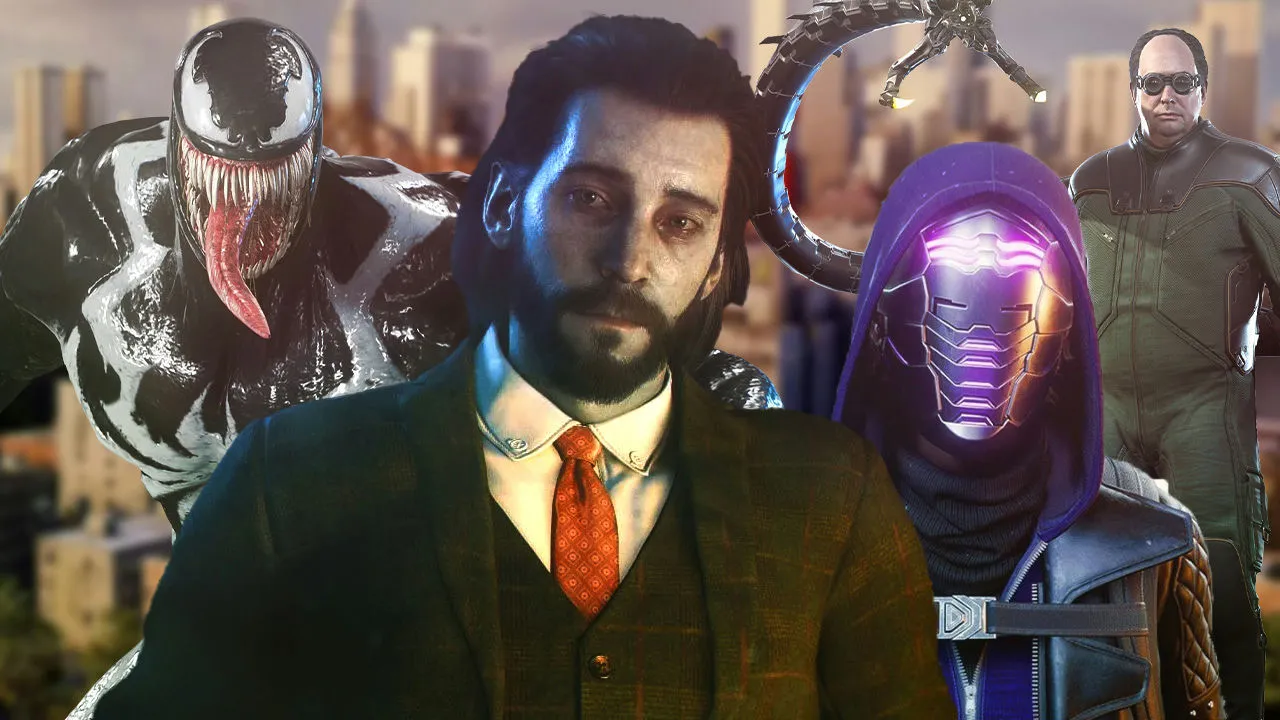
However, this alternate take on one of Marvel’s greatest villains had an unfortunate consequence: it worked so well that Insomniac has tried to replicate it in each subsequent game. The Tinkerer in Miles Morales, Venom in Spider-Man 2, and now Sinister in Wolverine are all former friends of each game’s protagonist, and all these stories are made worse by trying to redo what worked in the studio’s first Spider-Man. Phin Mason, aka the Tinkerer, is a supergenius friend of Miles who wants to attack the Roxxon Corporation, and falls into the all too common stereotype of leftist coded villains who have a “point” but are too cool with murder and therefore defined as evil by the plot. Her master plan to destroy Roxxon HQ puts all of Harlem in danger, and while the game tries to handwave this by saying she was unaware of the real blast radius because of a miscalculation, that’s an attempt to salvage her morals that also makes her look like an idiot. She also dies to get “redeemed,” which makes the whole arc feel pointless.
Harry Osborn is turned into Venom in Spider-Man 2, and while Harry is not traditionally one of the hosts of the Venom symbiote, the idea was at least foreshadowed in the previous game because of the symbiote being inside of his recuperation chamber. Yet his transformation into Venom makes no sense. He wears the symbiote with no ill effects for a while before giving it to Peter, who immediately turns into a dick because of the suit’s influence, and when Harry gets the symbiote back he transforms into a monster who doesn’t share his motivations. Sure, Venom claims he wants to “heal the world” because that’s something Harry said before, but he’s actually trying to conquer the world with a symbiote army, and the final boss fight makes it clear that Harry is basically a prisoner of the suit instead of being responsible for his actions, rendering the supposed tragedy of the conflict inert.
These diminishing returns hit a new low in Wolverine, where Essex doesn’t have a clear motivation for putting up a charade of heroism for so long. Essex acts heroic only so there can be a “twist” later on that he’s not, and the multitude of scenes where Logan and Essex yell at each other after the reveal don’t feel like former friends who can no longer see eye to eye so much as the script feeling obligated to have dialogue scenes between major action setpieces. By the time we get to the final boss fight, Essex is gleefully reciting cliché after cliché about “I am the future!” and “You have no chance!”, creating a climax that can be enjoyable as spectacle but is devoid of depth. It’s a sad state of affairs given how long the game was in development and how much the studio was clearly passionate about the property.
This is not to say that future Insomniac Marvel collaborations are doomed, but if the studio wants to get back on top, it needs to take a hard look at its storytelling instincts. Hopefully by the time we get to Spider-Man 3, the Venom spin-off, or the X-Men game, Insomniac will learn that for supervillains, one size most definitely does not fit all.
Carlos Morales writes novels, articles, and Mass Effect essays. You can follow his fixations on Twitter.