






Editor’s Note: This review currently only covers Ace Combat 8’s single-player campaign, as reviewers were given a very limited amount of time with its multiplayer modes ahead of release. It will be updated with a finalized score and multiplayer impressions once we put the PvP through its paces on live servers.
There’s a theory that it’s impossible to make a piece of anti-war art set during a war – that, no matter what you do, the work itself inevitably becomes (or will be interpreted as) pro-war. I’m sympathetic to the argument , Ace Combat 8: Wings of Theve is a war story about how awesome it is to be a heroic ace pilot. It is also unapologetically anti-war and plays with complex ideas like the role of propaganda, the power of symbols, nationalism and globalism. And it extends to the way corporations influence and manipulate world events, social media and the rise of news that may or may not be real, the price and horrors of war, and what a world without borders might look like. Its story is often startlingly relevant, but when I think about my time with it, my mind returns to a single thought: Wings of Theve’s never directly stated but deeply held belief that the best thing that could happen to this world and its characters would be for the war to be over, and for none of them to ever fly a combat mission again. It marries exceptional air combat with a melodramatic but moving story, one of the year’s best soundtracks, and incredible visual design to make a war game that never lets you forget how terrible everything happening here is.
Wings of Theve takes place about ten years after Ace Combat 7, though you don’t need to be familiar with its predecessor to enjoy it. The Republic of Sotoa launches a blitzkrieg invasion of the Federation of Central Usea using the power of its air force and orbital missiles strikes known as Tonitrus Spears. The FCU capital of Theve falls. Shattered and broken, what’s left of the FCU fights a hopeless, defensive war from the deck of the Endurance, an aging aircraft carrier that, in better times, would have probably ended up as a museum, but the crew of the Endurance fights on. Your character, a nameless fighter pilot, is fished out of the ocean by one of the Endurance’s rescue helicopters, and you’re quickly assigned to fly second seat to Jan “Rex” Cope, the legendary Wings of Theve, the FCU’s ace of aces.
Trouble is, it’s all a lie. Cope is an exceptional pilot, but he’s never shot anyone down. His kill count is a myth, fabricated to give the people of Usea hope. As long as the Wings of Theve is in the skies, the story goes, the fight isn’t over. Cope’s job is to bring his squadron, Joker Flight, back with him. And he’s done it well. But his luck runs out when you run into Sotoan ace Shadow 22. But the Wings of Theve cannot die, so you inherit the mantle and Cope’s old callsign. You have become the name. And when legend becomes fact, print the legend and watch it go viral on social media. But it’s not enough for Joker Flight to just run anymore. They need to produce results. And as you start to shoot down enemy fighters, the lines between the legend of the Wings of Theve and reality start to blur.
It’s a compelling yarn that developer Project Aces has spun, and it unravels into an earnest story with the Joker Flight crew at its heart. Baxter (callsign “Professor”) is a former teacher turned pilot, mentor to the other members of Joker Flight, and your wingman , Tasha, Joker Flight’s youngest member, a generationally-talented civvie stunt pilot forced into service by the war who refuses to shoot anyone down , and Coster (callsign “Noise”), a quiet rock and roll enthusiast who manages to fly Tasha’s wing while blasting tunes over your comms. Many other supporting characters feed into the myth of the Wings of Theve whether it be your commanding XO, your Queen Flight counterparts, or the media machine spinning you up. And through it all, the legend of Cope (and his spirit) lingers.
Maybe that sounds silly, but like everything else in Wings of Theve, it works surprisingly well and allows you to continue to build a connection to a character whose life and death are crucial to Wings of Theve’s world. And make no mistake, it is Wings of Theve’s characters that make this story work. They’re well-drawn, complex, interesting people elevated by genuinely excellent performances from the voice cast and your relationships with these characters drive much of Wings of Theve’s story. Whenever we sortied, I wanted to make sure I brought them home.
Ace Combat has long told its story from inside the cockpit, but Wings of Theve also puts your character on the Endurance’s deck, inside the mess with your fellow pilots and civvies who have sought refuge on the carrier, and inside hangars briefing rooms, among other places. These moments help you connect with the members of Joker Flight and the other people aboard the Endurance, but they also drive home the cost of the war, and make it feel like this world exists outside of the cockpit. You can’t really do much during them except look around and perform simple interactions, but they’re home to some of Wings of Theve’s most memorable and affecting moments.
Ultimately, though, you’re a combat pilot , your place is in the air. And it’s here that Ace Combat soars (sorry), expertly weaving its story, moment-to-moment gameplay, and mission design into masterful, elegant maneuvers worthy of a state-of-the-art fighter jet. Like its predecessors, Wings of Theve is a mission-based game. After you’ve been briefed on your next sortie, you’ll select your aircraft, weapons, and parts – which you can buy (along with new planes) with points you earn by completing missions. All that affects everything from how many missiles or special weapons you can equip or how much damage they do to how well your plane handles. You can even outfit your crew’s planes if you want (or have them auto-assigned something that fits the mission at hand). Then you’re airborne, and it’s time to fly.
Often, things start pretty simply. Maybe you need to defend the Endurance, assault an air field, protect a friendly plane, or take out some transports. But these initial objectives are just a reason to take to the air. The beauty of Ace Combat has always been in its flying, when the infinite possibilities of the skies above intersect with the limitations of your aircraft and the realities of your mission. You could play with the standard controls, which substantially limit your aircraft, but you should absolutely play with the Expert scheme if you can. The joy lives in the complete control of the pitch, roll, and yaw of your plane, simultaneously opening you to rapturous moments of aviation choreography and shattering mistakes when you misjudge a turn or your altitude resulting in a devastating crash.
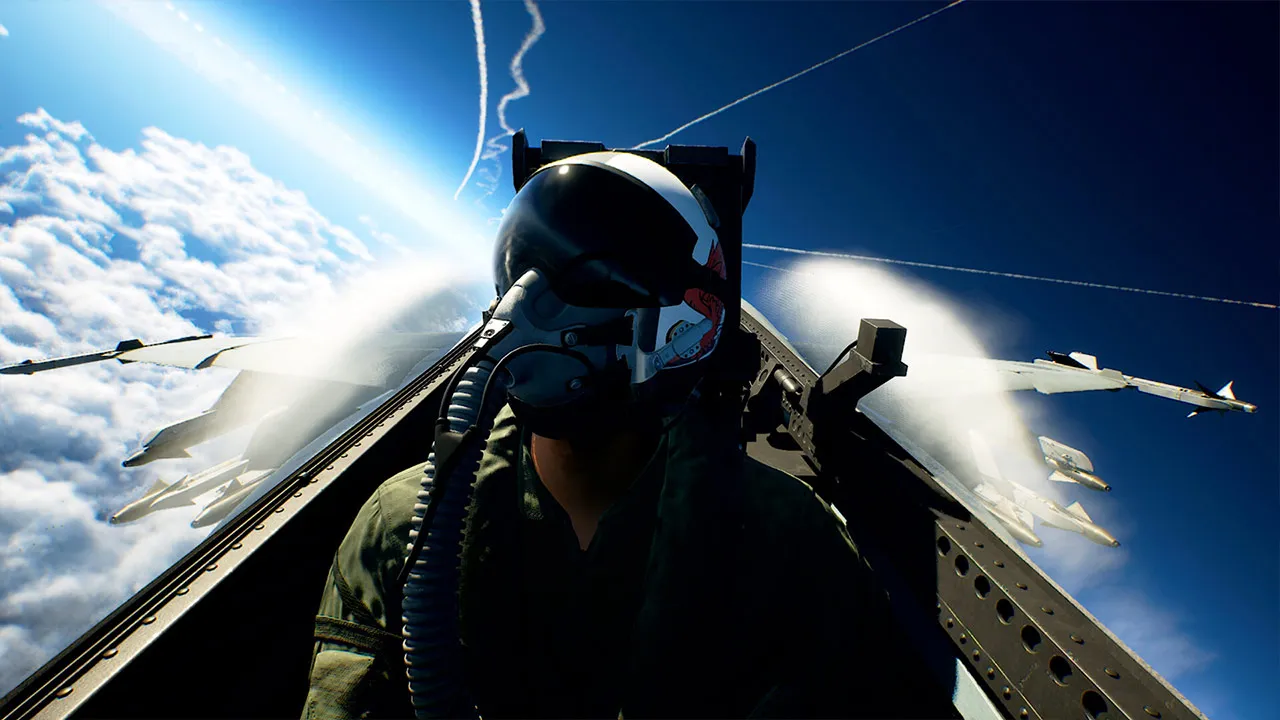
You find yourself in small moments: in the high-G turns to evade incoming missiles, locking onto a group of planes with a special anti-air weapon and knocking four of them out of the sky at once, or deftly weaving through a city and over debris. Wings of Theve captures the fighter pilot fantasy when you’re getting on a target’s six and downing them with a perfectly placed series of machine gun shots or in finding just the right air speed to stay behind a massive transport before turning your nose and shredding its engines with your guns without ever firing a missile.
You can be perfect in Wings of Theve if you try, and that’s when pilot and aircraft merge and flight becomes an extension of human expression in spite of the limitations of weight and gravity. Each moment and small choice builds the future of your sortie in real time. It’s in tailing a Sotoan plane, your reticle turning red, the lock on tone roaring in your ears, and launching a missile and watching it arc elegantly into the other plane’s fuselage before flying through the wreckage in search of your next target. Destruction as beauty. Wings of Theve consistently delivers on this thrill, and it is exhilarating each time.
But what is remarkable is how Wings of Theve marries these moments with its mission design and story. Sometimes, you’ll have your targets marked for you, but often it’s on you and the rest of Joker Flight to figure out where to be. Maybe your radar is jammed, and you can’t track the transport planes you need to shoot down, so you’ll need to pick out the contrails they leave behind among the clouds and follow them. Or perhaps a ground detachment is under attack, and calls for aid on your radio. You’ll have to figure out where that detachment is, what you need to target to help, and how to approach it. Can they hold position for a minute while you handle threats elsewhere? Do you dispatch Joker Flight to help, authorizing the use of their limited special weapons, or keep them flying close formation to cover you and try to do it yourself? Missions in Wings of Theve change constantly, and your objectives will change depending on the state of the battlefield. It is a brilliant, graceful ballet where new dancers constantly take the stage, and you must improvise the steps accordingly.
My favorite missions put the ball in Joker Flight’s court. In one, we had to fight off a Sotoan land battleship (think a battleship with tank treads). As we dodged fire from its massive railguns, we also had to cover our ground troops and take out its weapons. It was a tough fight , I’d brought bombs that excelled at destroying its weapons but struggled when we needed precision targeting near the armor around its treads. In another mission, we had to take out airships that helped Sotoa target its Tonitrus Spears. They were hidden in the clouds and invisible from radar, so between fending off air attacks on the Endurance’s fleet, we would follow the massive lasers that guided the Spears once the airships aimed at their targets, and destroy them before they annihilated our fleet.
All of this is brilliant stuff that tests not only your ability to pick the right aircraft and weapons for the job – though you could stick with the capable default F/A-18C, just not as impressive as my beloved F-22A, for example. But it’s also about responding on the fly to dynamic objectives that may be very different from your original briefing and the mission you’d planned for. I’ve stuck mostly to talking about the first half of Wings of Theve’s 30 missions here to avoid spoilers, but every single one is excellent, and the final missions pull out all the tricks for some genuinely showstopping moments.
Wings of Theve’s narrative triumph is in portraying most of its drama through the calls coming in over your comms. When your forces are taking heavy losses, some soldiers will urge their comrades to fight on because the Wings of Theve is protecting them, while others will question your usefulness or if the stories about you are even true. You’ll hear men and women die in combat because you weren’t fast enough or just couldn’t protect them. Joker and Queen Flights will react to what’s happening in real time. “Hello traitors, did the wicked get their rest?” Tasha will taunt a former FCU squadron now fighting for Sotoa. Coster will play music to inspire the rest of the crew, and you may end up flying with the guys who recorded it. Sotoan forces will come through on your radio, calling out for their friends as you shoot them down, talking strategy, or taunting you. And then the Shadows themselves might announce their presence by singing over an open channel – that’s when you know you’re in for a serious dogfight (I still can’t get that tune out of my head).
All of this combines with standard combat chatter, but it’s never overbearing as you’ll always know what’s happening. It’s a remarkable achievement in audio mixing, and more impressive that Wings of Theve manages to tell a compelling, emotional story this way. Like previous games in the series, Wings of Theve is a melodrama, and that might turn some folks off, but I found it exceptionally compelling and full of pathos. It’s most effective in its smallest moments – when Tasha confronts the cost of her pacifism, or when Coster gets to meet his musical heroes in the skies. And it extends to just the banter between the crew that fills the quiet moments before or after a mission.
When we had to listen to FCU ground forces calling for help and reporting their losses, wondering aloud if Wings had abandoned them, I felt bad. Keeping them safe was my responsibility, but much of what happens in any given mission is out of your control, no matter how well you fly. That’s war, but it always made me try harder, fly better, and refocus. I had to live up to the legend, whether it was true or not. And while shooting down Sotoan forces and watching them realize they had no chance in real-time was satisfying, it was essy to understand their anger over what had happened to their comrades or their fear when we turned the tide. As exhilarating as being a fighter pilot is, Wings of Theve never lets you forget that everything happening here is a tragedy. And it doesn’t shy away from portraying the toll of war not just on the people forced to fight it, but on civilians who live through it, too. There is a cost to all of this, and the storytelling drives that home every time it can. And yet, you can’t help but want to be everything the Wings of Theve are cracked up to be, to instill hope for desperate people fighting for their right to live free of oppression. Every time I climbed into the cockpit, Wings of Theve reminded me that I was a symbol, more powerful than any combination of pilot or plane could ever aspire to be. The challenge was to live up to it.
Some of my favorite moments in Ace Combat 8 are when there’s no fighting: flying through immaculately rendered clouds, drops of rain speckling my canopy, or landing on the Endurance or at an airstrip after a job well done, or unlocking a new plane and watching the massive hanger doors open and light spill across its sleek lines for the first time. There’s something beautiful about skimming the clouds and basking in the sun in a sky free of missiles and machine gun fire. While you can replay missions and aim for higher scores and S-ranks like me, Ace Combat is kind enough to let you fly around any map peacefully once you’ve completed its associated mission. Cope understood that feeling , maybe it’s why he never shot anyone down. And the longer I played Ace Combat 8, the more I understood him. Maybe he had it right all along.
Ace Combat 8: Wings of Theve is a remarkable achievement for Project Aces. It combines stunning visuals and sound design (seriously, Bandai Namco, please sell this soundtrack) with engaging story moments, whether they’re out-of-the-cockpit sequences or the radio chatter that build up its excellent, memorable characters. It’s also a surprisingly emotional and resonant story that’s deeply relevant to the current age while delivering the best aerial combat the series has ever had alongside some of its best mission design. I haven’t been able to stop thinking about it since I stepped out of the cockpit for the last time, and I know the Wings of Theve, and their story, will stick with me for a very long time. For now, perhaps it’s enough to hope for a world free of nations and war, one where we soar the skies freely for ourselves. And like the Wings of Theve, by believing in it, perhaps we can make it real.