I vehemently dislike reviewing laptops. I know that’s a weird sentence to start an SSD review off with, but humor me for a second. Basically, the configuration you get is never correct. You go “oh hi X manufacturer, this laptop looks great, can you send me a sample for review?” and they go “yeah, sure, this is the model” and it’ll arrive on your doorstep, and it’s some weird hybrid amped up special edition with extra RAM, a different storage setup, and a screen that you can’t find anywhere else except from some odd retailer eseller based in the Seychelles, for some reason.
At that point you’ll then proceed to spend the next three hours of your life trying to source a price for the thing that’s even remotely similar to the one you have, and then scream because without a price tag reviewing the thing becomes damn near impossible.
Sadly, in the last year or so, SSD reviewing has followed a remarkably similar path. 33% of the time the SSD you get, doesn’t have the same NAND and controller that it actually launched with, 33% of the time its price has been ricocheting back and forth to the point it doesn’t resemble anything close to the launch price, and the remaining 33% of the time manufacturers will just flat out tell you “sorry we’re no longer sampling SSDs due to challenging market conditions.” Eugh…
Latest Videos FromPC Gamer
So firstly, let me just say, Kioxia, you bloody legends. Well played. I did not expect to see another SSD review in my career, genuinely, and yet here we are. You had the brass balls to launch a consumer product in the middle of a NAND “drought”, and provide reviewers with samples to critique, and I gotta respect the hustle.
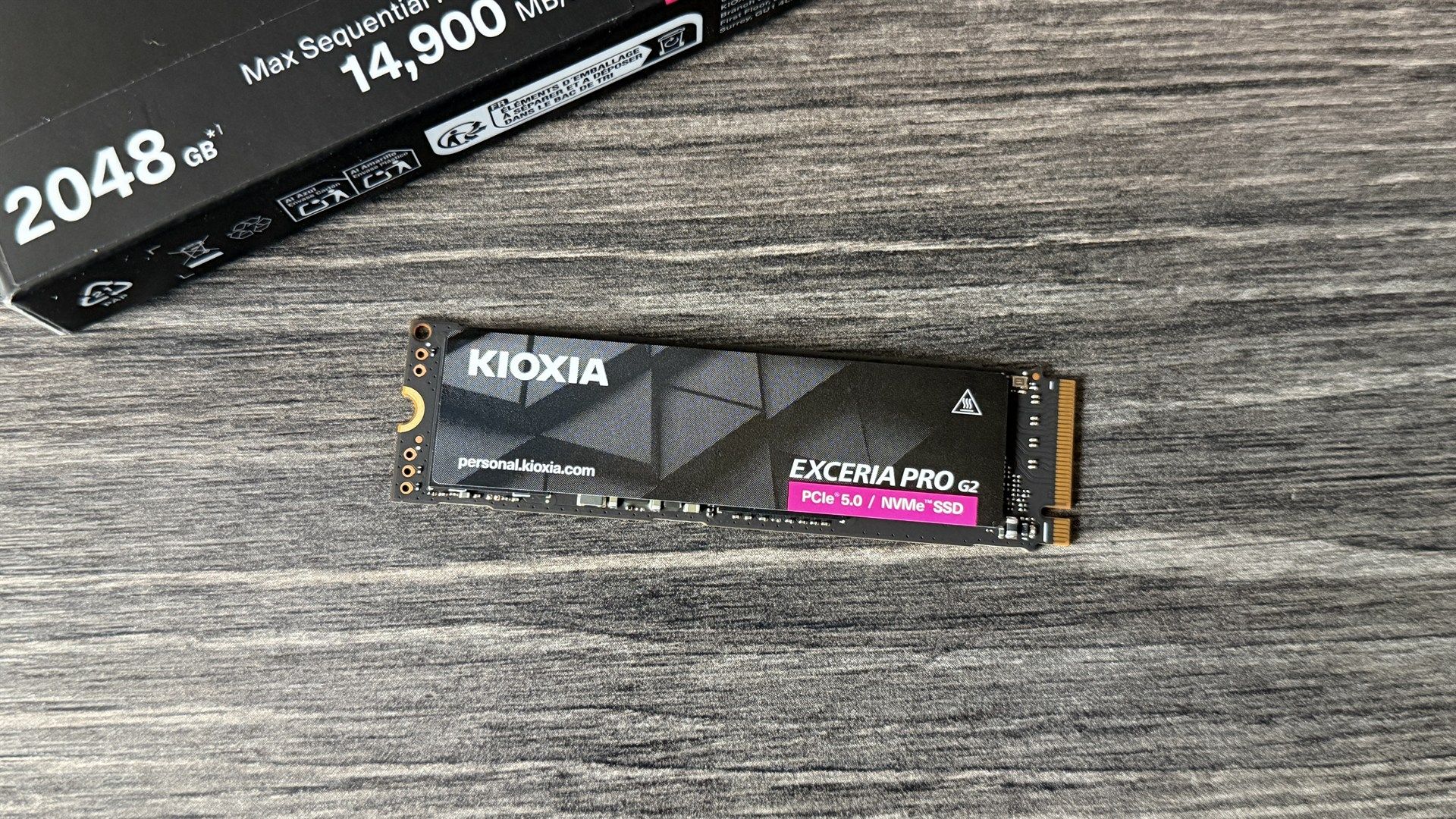
Anyway, this is the Kioxia Exceria Pro G2, and it is a fascinating little drive. And not just because Kioxia actually sent me one. The hardware alone is interesting enough.
The beating heart of this thing is Silicon Motion’s SM2508 8-channel controller. This is the same one that’s found on a whole plethora of SSDs of times long past when you could actually buy one, including Kingston’s Fury Renegade G5, and the (I’m still calling it) legendary SanDisk WD Black SN8100.
Similarly, it also packs in that Kioxia 218-layer BiCS8 TLC NAND as well, because, well, you know it’s Kioxia. Be a bit weird if they didn’t. With that, you get 2GB of LPDDR4X and a tasty 1,200 TBW endurance rating, all bundled into a single-sided M.2-2280 design. Nice.
Keep up to date with the most important stories and the best deals, as picked by the PC Gamer team.
Image 1 of 3
(Image credit: Future)
(Image credit: Future)
(Image credit: Future)
Pricing is, well, difficult , true launch day laptop madness. Already this thing’s out of stock almost everywhere. You can pre-order one in the UK for about £350 from Overclockers, and in the US there’s some lovely “resellers” that will kit you out with the thing for the super low, low price of, ahem, $750. Boy, I love scalpers. I mean, thanks guys, glad you’re not profiteering off other people’s suffering like you usually do (please don’t buy it at that price point).
For those not in the know, that BiCS8 is the real star of the show here, particularly when paired with the SMi controller. It made waves with that SN8100 back in the day, and with good reason, as that fated combo delivered some exceptional random 4K performance, which is a core driver in terms of game load times, and it was actually developed as a joint partnership between SanDisk and Kioxia directly.
SSD benchmarks
We test solid state drive performance via a range of tests, including game load times.
Average Access Time (µs)
Kioxia Exceria Pro G2 2 TB | Gen5
WD Black SN8100 2 TB ¦ Gen5
SK Hynix Platinum P51 2 TB | Gen5
Biwin Black Opal X570 Pro 2 TB | Gen5
Acer Predator GM9000 2 TB | Gen5
3DMark Storage Data
Product
Value
Kioxia Exceria Pro G2 2 TB | Gen5
3205 Index, 554.42 Bandwidth (MB/s), 56 Average Access Time (µs)
WD Black SN8100 2 TB ¦ Gen5
5607 Index, 939.35 Bandwidth (MB/s), 31 Average Access Time (µs)
SK Hynix Platinum P51 2 TB | Gen5
4167 Index, 706.57 Bandwidth (MB/s), 43 Average Access Time (µs)
Crucial T710 2 TB | Gen5
4553 Index, 771.23 Bandwidth (MB/s), 39 Average Access Time (µs)
Crucial P510 1 TB | Gen5
3132 Index, 530.36 Bandwidth (MB/s), 57 Average Access Time (µs)
Biwin Black Opal X570 Pro 2 TB | Gen5
3364 Index, 567.67 Bandwidth (MB/s), 53 Average Access Time (µs)
Acer Predator GM9000 2 TB | Gen5
2575 Index, 436.56 Bandwidth (MB/s), 69 Average Access Time (µs)
8.332 Total Loading Time (seconds), 1.223 Scene #1 (seconds), 2.068 Scene #2 (seconds), 2.525 Scene #3 (seconds), 1.67 Scene #4 (seconds), 0.846 Scene #5 (seconds)
WD Black SN8100 2 TB ¦ Gen5
6.575 Total Loading Time (seconds), 0.754 Scene #1 (seconds), 1.693 Scene #2 (seconds), 2.134 Scene #3 (seconds), 1.273 Scene #4 (seconds), 0.655 Scene #5 (seconds)
SK Hynix Platinum P51 2 TB | Gen5
6.876 Total Loading Time (seconds), 0.817 Scene #1 (seconds), 1.785 Scene #2 (seconds), 2.185 Scene #3 (seconds), 1.401 Scene #4 (seconds), 0.688 Scene #5 (seconds)
Crucial T710 2 TB | Gen5
6.834 Total Loading Time (seconds), 1.023 Scene #1 (seconds), 1.689 Scene #2 (seconds), 2.122 Scene #3 (seconds), 1.344 Scene #4 (seconds), 0.656 Scene #5 (seconds)
Crucial P510 1 TB | Gen5
8.075 Total Loading Time (seconds), 0.866 Scene #1 (seconds), 1.977 Scene #2 (seconds), 2.498 Scene #3 (seconds), 1.853 Scene #4 (seconds), 0.881 Scene #5 (seconds)
Biwin Black Opal X570 Pro 2 TB | Gen5
8.301 Total Loading Time (seconds), 1.171 Scene #1 (seconds), 2.045 Scene #2 (seconds), 2.578 Scene #3 (seconds), 1.685 Scene #4 (seconds), 0.821 Scene #5 (seconds)
Acer Predator GM9000 2 TB | Gen5
8.025 Total Loading Time (seconds), 0.984 Scene #1 (seconds), 2.078 Scene #2 (seconds), 2.557 Scene #3 (seconds), 1.683 Scene #4 (seconds), 0.724 Scene #5 (seconds)
So, let’s talk performance, because on paper it seems like the Pro G2 is a surefire win. The hardware’s there after all, and it’s certainly got the pedigree. Unfortunately, what it lacks is the real-world results compared to those aforementioned SSDs, and I’m not quite sure why that is. Well, I am , it’s the firmware, but whatever the stock Kioxia code is doing, it’s not quite hitting the wham-bam hammer of some of its contemporaries.
(Image credit: Future)
Compare it against that Fury Renegade G5, for instance. With temps equated, it’s 5 degrees hotter, yet in 3DMark results are nearly 2,300 points lower, with SSD bandwidth nearly halved by comparison. More akin to the results of the Exceria Plus G4 (which also featured that same NAND). Sequentials do well at 14.7 GB/s and 13.3 GB/s respectively, and the random 4K performance too puts out delivering a suitable showing of 90 MB/s on the read and 311 MB/s on the write, but they’re hardly breathtaking numbers, compared to the SN8100.
And then there’s Shadowbringer and the dreaded load time test, and boy, is this one painful. 8.332 seconds on the total load time. That ain’t good, chief, especially compared to the other drives on that list. In fact, it’s one of the slowest I’ve seen, coming close to what Acer managed to achieve with its GM9000 (now aptly rebranded as the G9, by the by).
(Image credit: Future)
Buy if…
✅ You need a decent SSD and it’s in stock: At its launch price, the Exceria Pro G2 is genuinely solid value, particularly with that top-tier PCIe 5.0 sequential speeds.
Don’t buy if…
❌ You’re looking for SN8100 performance that’s available today: Whether it’s a mix of hardware and firmware, the Exceria Pro G2 just doesn’t quite keep up with its older predecessors.
In normal times, in these situations where a manufacturer sells an SSD directly like this, you expect two things to usually be the case. Firstly, you’ll get an undermarket rate, as there’s no middleman siphoning off license fees, as Kioxia manufactures that NAND directly. And secondly, you get pre-binning. Where Kioxia will take the best of the best NAND it has, pair it with the best controllers, and deliver exceptional results as a consequence, maybe tuning the firmware to run a little hotter to get the numbers it wants.
And here’s the thing: I don’t think the hardware stock is actually available to even do that anymore. So much of it has been sucked up into data centers, and there’s so little spare to go around to consumers that there’s a chance that potentially, this is the best of what’s available, at least to us. And I think this goes beyond Kioxia, but it may even be industry-wide. If, for instance, you took one of SanDisk’s WD SN8100s today, fresh off the line, I do wonder if it would bench the same as those samples I got way back when.
That’s not to say the Kioxia Exceria Pro G2 is bad. It’s all-in-all, solid, dependable, average. Hell it might even legitimately be good compared to its modern counterparts if my theory is anything close to true, and its the one brand that’s sincerely managed to keep stock available on some of its other PCIe 5.0 offerings too (the Exceria Plus G4 2TB is still available right now for $230 and £240), when the rest of the world has shut shop and left us fighting over scraps.
I don’t know what to say. The G2 is interesting. It’s shone a light on the conditions we currently inhabit. Is it the best value? Not really. The best performing? No. But it is a solid all-rounder, and the fact that it even launched at all is doing more for Kioxia than I think any of us actually realise.